STITCHES I WILL ALWAYS USE
Month 1
Expanding from Tent Stitch
welcome to Parisian and Cashmere
Couple of things before we dive in to stitches.
There is no particular order of progression for the stitches.
Meaning, we are not beginning with the easiest making our way to the harder.
All the stitches presented in this series are organized by “what for”.
We’ll skip around the structures and uses – provide some pairs or variations.
There will be no overtly challenging stitches, though depending on your familiarity
with stitches beyond the four basic needlepoint stitches, some stitches may seem challenging to you.
For those who have ventured into alternative embroidery stitches, you may already know some of the stitches.
When any stitch has one or more variations , those stitch lessons will be about the variations.
When any stitch has more complex variations and you would like to learn more complex for that stitch, just email us.
A blank canvas, skein of silk thread and gold needle have been sent so you can execute – Doing is learning.
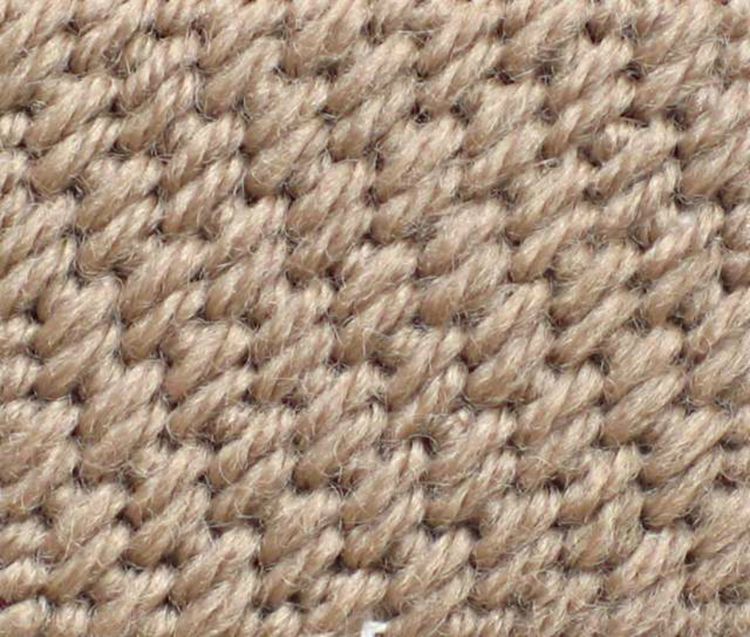
PARISIAN gives excellent coverage across small areas of a canvas.
It has a lot of uses.
With neat vertical stitches it has great texture. Some ideas: small backgrounds, borders, vases,
pottery, walls in a house, and is equally fun for details in whimsical designs.
Looks great in one color, and more emphasized when using two colors.
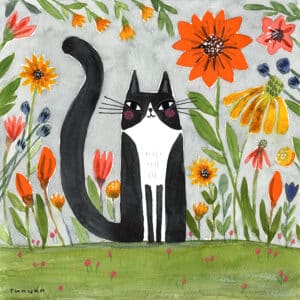
Small areas can mean the tail of a cat such as the whimsical Abundance by Terry Runyan –
there’s plenty of space and the tail goes up – and the Parisian can fit in the wider and less wide areas of this tail.
~~~~~~~~~~~~~~~~~~~~~~~~~~~
Parisian can be used as a background – you can shorten the stitches (go over fewer holes)
when the stitch won’t fit the space you want to fill – it’s easy to compensate with.
~~~~~~~~~~~~~~~~~~~~~~~~~~~~~~
Parisian can be used for details such areas of a bird body,
whether a small Cardinal or Robin; Penguin or Flamingo.
~~~~~~~~~~~~~~~~~~~
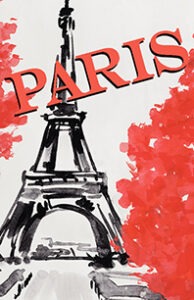
Parisian can be used for skies – see the Paris canvas below for a clear sky –
even though it has a pattern, it is considered a resting stitch
– your eyes rest when they see it – and the details in the foreground become the focal point.
~~~~~~~~~~~~~~~~~~~~~~~~
It’s a beautiful stitch – have fun practicing it with the canvas we sent.
If you have an easier time watching how to make a stitch,
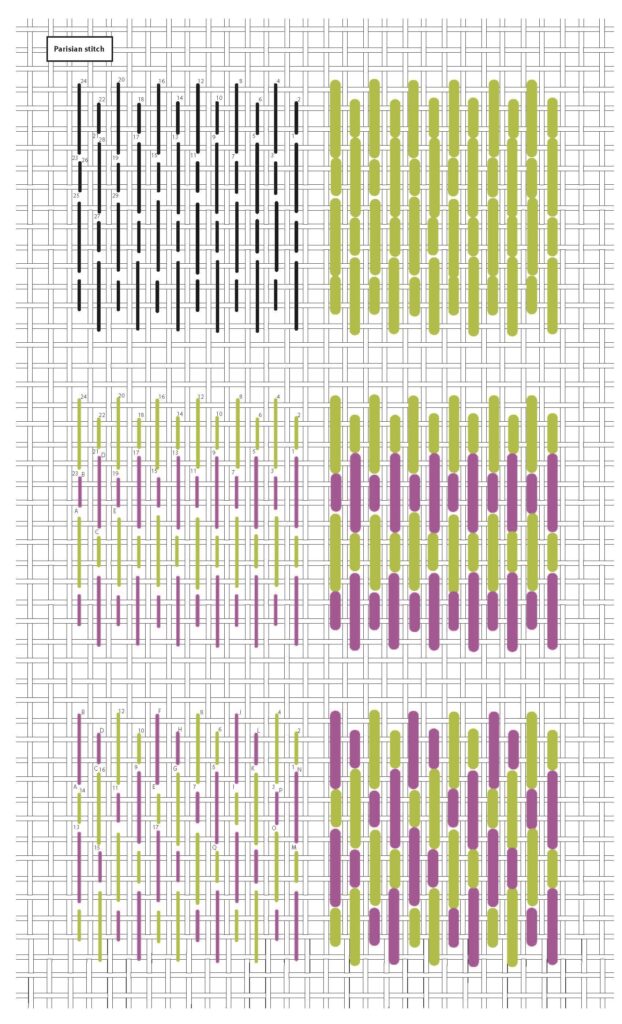
in addition to a diagram, type Parisian Needlepoint Stitch
into your browser
and go to videos and watch it being stitched.
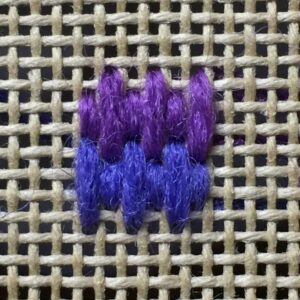
In Summary, the Parisian stitch according to RSN
is a medium sized flat stitch
consisting of long and short stitches worked in horizontal bands that give a vertical feel.
WHO DOESN’T LOVE CASHMERE?
Cashmere is not just for sweaters – although the Cashmere stitch can nicely fill in a sweater on a needlepoint canvas.
The Cashmere stitch is a must have. Very easy to execute.
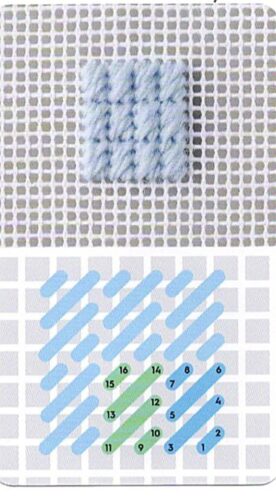
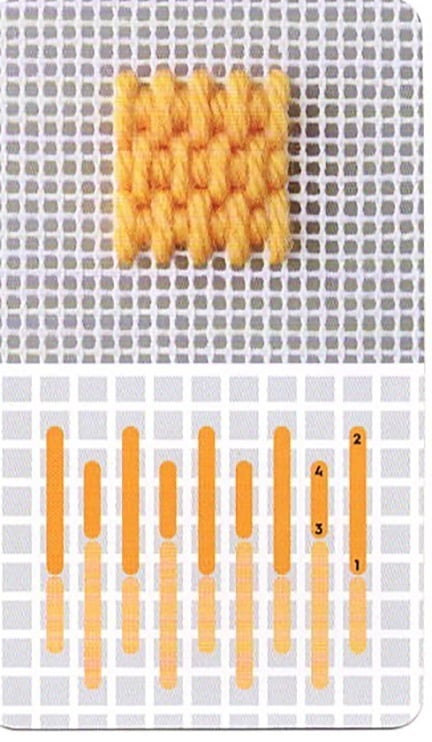
Pictured above and below is the general Cashmere stitch.
Diagonally stitched rectangles, two threads wide and three threads high, made up of four diagonal stitches.
The blocks repeat with each block sitting in line with those beside, above and below to form a grid. (RSN)
You work the rows above one another.
It’s basically a Continental, then a long stitch (anything over 1 hole) over two intersections, then another Continental.
You can do this stitch as a vertical or horizontal.
It has variations, which we will be getting to further on: Slanting, Reverse, Cascading and Condensed.
~~~~~~~~~~
Some call it a precious stitch. Or a dainty stitch. We find it impactful – a must have!
It is a stitch that relaxes you and a canvas without disappearing.
Can be worked with nearly any thread, on any mesh size.
Think of this for backgrounds, as well as intricate details.
Building : roofs &walls, roads, clothing, animal bellies like the kitty above.
It plays nicely with Parisian and a host of other stitches that we will address further on in the series.
It is also a GREAT stitch for SHADING!
~~~~~~~~~~~~~~~~~
As with the Parisian, you can look up Cashmere Needlepoint Stitch
in a search and then go to a video and watch it
be stitched if that enhances looking at a diagram.
The MOST important thing is to stitch both of these on your canvas that we provide.
You can try both with the silk – and if you have another thread at home – try that one also if you like.
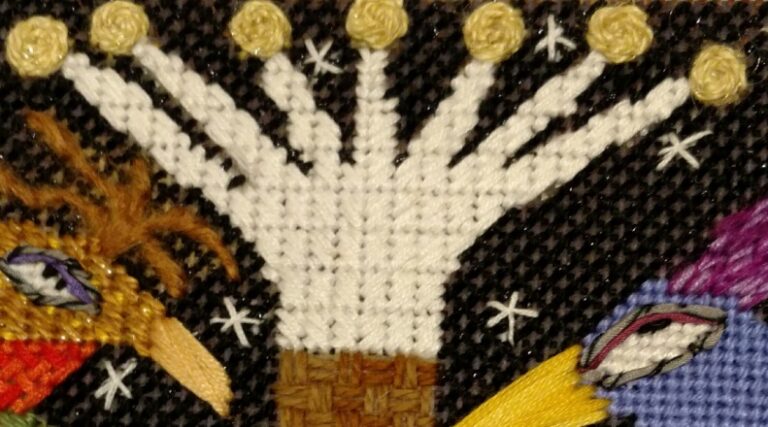
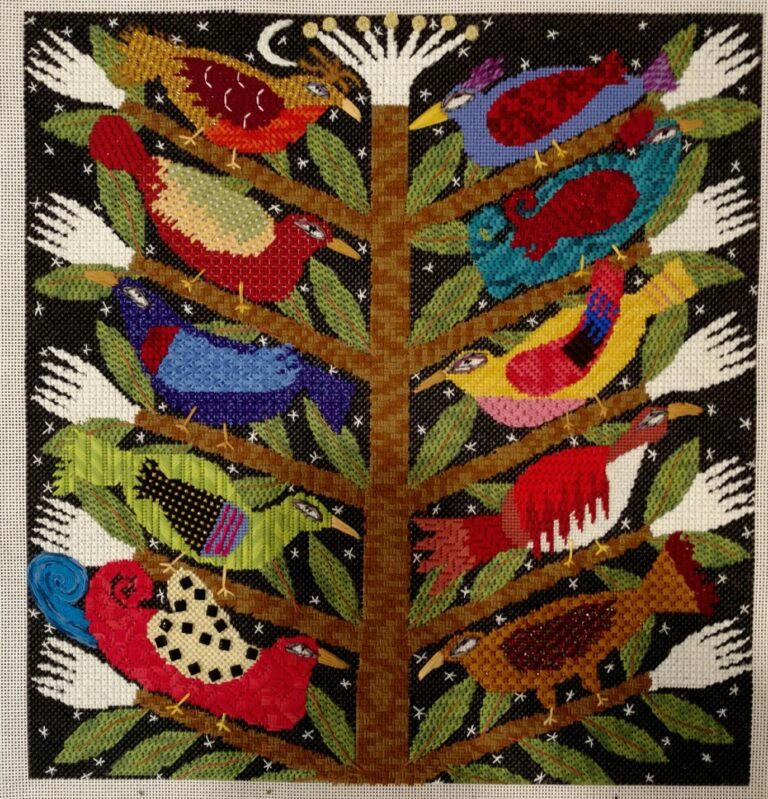
We find it to be a majestic stitch – so easy to do and it makes for a wonderful use of space such as the crown of the tree below from
the beautiful Night Birds by Chris Roberts- Antieau